

The parameters of the deal have finally been agreed on a new vehicle and the trade-in after a grueling afternoon of wandering the lots, making up the negotiations on the fly, and driving as hard a bargain as we possibly can over the past few hours.
It should be much easier from here, right?
That is EXACTLY what the dealer wishes you to think and to be so worn out and weary from the stress of the negotiations so that you let down your guard when it’s time to move to the Finance and Insurance (F&I) office where the actual money starts changing hands.
TIP: If anything, the F&I office is a much more perilous place to be with your wallet! Most of the profits on the car deal are going to happen in this office and you’re going to wonder afterwards how in the hell the actual financed price got so inflated! Now is the time to be extra vigilant to ensure that nothing gets slipped into the deal by the salesperson behind that desk!
Back in the bad old days, it wasn’t uncommon for extended warranties, GAP insurance, and pre-paid oil changes and all of the other products you find in the back-end F&I office to find their way into your deal and the first you’d see them would be buried in the mountain of paperwork (if you’re lucky and have not tuned out of the process by this point!).
I once had a dealer try slipping the prepaid oil change programme in at the last moment in F&I without disclosing that they’d done so. Fortunately, I caught it and made it very clear I wasn’t very happy with that stunt so they ended up zeroing out that line but giving me the six oil changes anyway.
But that’d have never happened if I hadn’t threatened to blow up the whole deal and walk out the door thanks to underhanded and shady tactics.
TIP: Just because you’re now in F&I and on the home stretch doesn’t mean the dealer can’t find a way to screw up the deal so badly that your best course of action is to leave. Use that to *YOUR* advantage if they try doing things that are a bit shady or underhanded.
Even the dealers have caught on to how much the old ways of “begging forgiveness rather than asking permission” has led to dissatisfied and unhappy customers that they’ve pivoted to the other extreme in terms of full disclosure via their new tool to give you the royal screw called THE MENU.
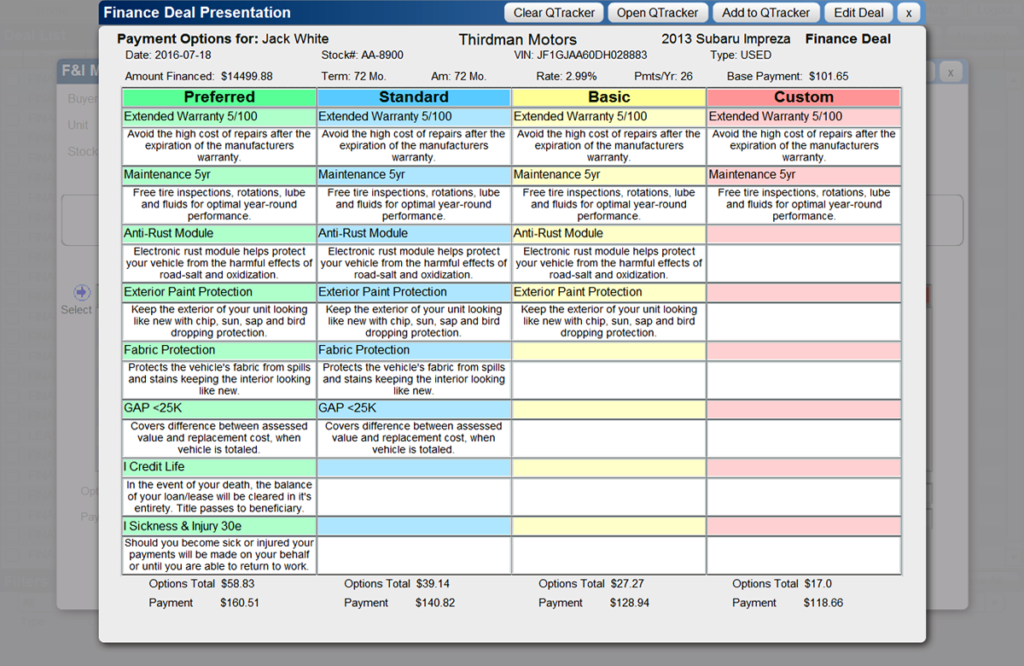
Mind you, I use that term advisedly because THE MENU is hardly new, it’s just a fantastically profitable variation on the FOUR SQUARE you likely saw in round 1 of the negotiation process in the wolf’s clothing of full disclosure!
Like it’s ugly quadrilateral cousin, there’s only one number that’s really designed to change on THE MENU and that’s the payment amount.
Everything will be pitched as a function of the difference that it makes to your ultimate payment that’s already got the term and APR factored into it.
Trying to flog a nearly $6,000 extended warranty onto the customer is extraordinarily difficult if the customer knows of that astronomical asking price up front. I don’t care who you are, plopping $6,000 into the deal above what has already been negotiated is going to give normal people who have more sense than money a breathtaking feeling of grodiness and a sinking feeling you’re being taken for a ride.
It becomes much easier for the F&I salesperson (and never forget that whatever else they may be, at heart they are a salesperson who has quite the interest in pumping up their commission!) to sell that warranty if they mention that “the peace of mind of getting bumper to bumper protection above and beyond the manufacturer’s warranty is only $90 per month more”.
The “smaller ticket” items on the menu are even easier for them to sell on payment terms as the per month rate isn’t quite as astronomical as the big ticket extended warranty and GAP coverage.
In a nutshell, that’s how THE MENU will be used against you.
Same shell game of numbers, same end result with the most amount of money extracted from your wallet.
Now can you see why it was so critical to invest the time required to push the “Adjusted Price” down as far as is possible?
Here in F&I is where it’s going to start coming back with a vengeance unless you are in a position to refuse all of the optional products they’re going to pitch at you!
TIP: know what F&I products you might have an interest in purchasing ahead of time and comparison shop comparable vendors other than the dealer to see if you’re being offered a good deal on the product. Nothing you see on THE MENU is mandatory, everything is negotiable and truth be told, the vast majority are of little to no use other than fattening the wallet of the dealer.
Over the years, my thinking on the extended service plan has changed markedly because years ago you’d have never caught me ever buying one. Instead of paying thousands for that coverage, I was far more likely to stick the same amount in an interest-bearing account and tap it in the unlikely event of a major failure.
However, in the intervening time, vehicles have gone from relatively simple and straightforward machines with an engine/transmission to high-tech computers that just happen to have tyres for you to ride down the road! Even the simplest of faults can lead to a couple of thousand dollars in parts and labour to say nothing of the hassle of having to arrange a loaner whilst your car is in the garage.
There’s so much technology that can go horribly wrong such that one failure may well wipe out what you pay for the extended service contract (and to be sure, recently paying out of pocket for a transmission replacement has certainly coloured my views on the subject!).
If you have something that looks like an iPad in the middle of your dash or many varied engine control modules (ECM) running the engine and drive train, it’s harder and harder to not want the peace of mind that major mechanical faults will be covered.
In Ben and Jessica’s case, I had figured given the big financial bomb that had gone off in their budget prior to arrival that they’d be likely interested in mitigating risk against a massive repair bill at the garage or getting the royal screw by an overzealous insurance adjuster totaling the car should the worst happen and then they’d find themselves “upside-down” owing the balance of the loan on a car that was no longer capable of being driven.
I was able to find some extended vehicle service plan vendors who were pitching long-term contracts at roughly $80/mo. The downside of those vendors compared to this plan that would be honoured at any Toyota dealer was that any repairs claimed against the contract would have to be pre-approved by the plan administrator.
If you remember having to get authorisation from health insurance for a procedure and how much fun that process…ISN’T…just keep in mind that getting the service contractor vendor to pay up is much, much harder and with a whole lot less accountability on their side of the ledger to boot!
TIP: if you’re planning on buying an extended service contract, make sure you keep every invoice and record of any maintenance work you have done to that vehicle. Just in case the service contract vendor tries to pull the “you’ve not been properly maintaining the car” nasty trick they use to deny the claim…
Likewise, my view on GAP coverage has evolved through the years as I’d always decline it when offered. However, insurance adjusters have gotten far more aggressive about totaling cars that would seem to be reasonably repairable. Once the claim gets round 70% of actual cash value or more, you can expect that the adjuster is just going to total your car and call it a day.
That doesn’t mean you automatically have to accept the number the adjuster comes up with. In fact, when I had my Volkswagen Passat destroyed by a careless driver on her phone who rammed a car at full speed which threw that car into me, her insurance adjuster was quite quick to decide to total the car and given the broken rear axle amongst other things, my dark red-coloured Vixen (which was the inspiration for the corporation’s name, BTW!) had definitely not survived the incident (which made me sad as I loved that car!).
He was also very quick to offer a really lousy low-ball offer that “is all I am authorised to offer” that frankly was right insulting. Unfortunately for him, his heavy-breathing boss listening in on the negotiations failed to mute their line and I knew full well that conversation wasn’t ending without a deal. $3,600 above that first “final” offer in a little over 30 minutes later that was agreed by that very same boss (who finally admitted to being on the call even though it was never disclosed) to arrive at a figure significantly above the fair market value ended up becoming the down payment on a red Sienna for the growing family. 🙂
Now, if I had a loan on that Passat with more of a balance owed than the adjuster paid, I’d have been screwed paying for a car that was no longer capable of being driven. That’s where the GAP policy comes into play and why you might want to consider it.
So I figured we’d probably ultimately end up going with the dealer’s service plan and GAP coverage anticipating that it’d be the least amount of hassle should they need to be used but knowing what those optional cover products go for in the real world outside of F&I was very helpful.
The rest of THE MENU is comprised of the utterly useless interspersed with occasional bits of bovine faeces and they’re generally the same expensive add-ons no matter what dealer you go with:
- Maintenance package – this will often be marketed as “free oil changes” or “free tyre rotations” but here on THE MENU, you’re paying for them up-front and burying them into your monthly payment, usually for several times what a trip to a reasonably competent mechanic that can do an oil and lube job.
- Rust-proofing – if it’s going to be done, this will likely have already been done before the car arrived on lot. Don’t waste your money on this unless you’re in a highly corrosive driving environment where the roads are salted routinely in winter or on the coast where you’re contending with salt from the ocean.
- Exterior paint protection – same as rust-proofing, it should have already been done. Besides which, are you really going to put in a claim for every dent and ding when you’re parking in the car park at the shoppes full of rogue shopping trolleys and inconsiderate drivers? If you’re driving a Ferrari or a McLaren, that’d be one thing but then you’d have enough money already to take care of that out of pocket.
- Nitrogen gas inflating the tyres – there may well be some saving in fuel efficiency but I’ve yet to see one instance where it was significant enough to notice to offset the absurd price charged for this much less the additional cost to maintain nitrogen in the tyres.
- Fabric protection – my absolute favourite hands down! It blows my mind how many people pay through the nose for that “protection” when a can of Scotch-gard will totally take care of you for about $10-15 tops. And it’d likely last the lifetime of the car unless you’re really hosing down your fabric with the stuff!
- Credit insurance / sickness insurance – most people will never need or use these as the repossession is likely going to happen well before your claim is submitted! Credit life insurance essentially duplicates what probate is already there for and quite expensively at that!
The three of us crowd into the F&I fish bowl with our new salesperson round a desk dominating by what looks to be like an iPad that’s evolved into a monstrously sized touch screen.

No, you’ve not gone back in time to the world of Tron where you’re in Dillinger’s office of ENCOM though I couldn’t blame you if that’s the first thought that comes to mind when you see the monster signing screen masquerading as a desk.
If you’re old and a nerd, that is. 🙂

However, the sheer amount of virtual paperwork that you’ll be signing on that screen may make you long for the days where your worst adversary was the Master Control Programme (MCP).
That volume of things that you’ll be signing is no accident. Part of it is unavoidable given the legal intricacies of the various players in the selling/trading of cars to ensure that the titles and registrations are correct but there’s going to be a lot of legalese coming your way and the F&I salesperson is going to try to breeze through it all as quickly as possible so they can move on to the next opportunity for padding their commission.
This is where you absolutely have to resist any of the dealer’s efforts to speed up the process to any faster than you’re comfortable with.
We arrived in F&I round 1900 hours (that’s one hour after they closed the front doors) and there was another deal in progress one office over. If it’s gotten this far, they aren’t leaving until the deal is done or dead!
And wouldn’t you know it, THE MENU is prominently displayed on Dillinger’s desk so of course I’ve got to throw a monkey wrench into the prepared order of the spiel by asking to see the Buyer’s Order and Retail Sales Contracts first before we bother with any of the F&I products on THE MENU but not before I saw the APR they were offering was 8.69% (I know the Fed’s interest rate rises have been impressive but that’s the worst number I’ve seen offered as an auto interest rate in at least 30 years!).
The main reason is that those two documents are the starting point for everything else that’s going to happen in this fish bowl office and it’s the quickest way to see if anything has been slipped into the numbers in that little trip from the sales cubicle on the showroom floor and the F&I office.
The Buyer’s Order is the place to start because you’re going to want to see “Price of Vehicle” equals the “Adjusted Price” you negotiated in the showroom and further below that the “Trade-In Allowance(s)” match what was agreed. Don’t worry too much about any other numbers you see on that form because they’re absolutely going to change once the negotiations on the F&I products begin. But the nice thing is that you’re going to see the worst-case scenario numbers they’re going to pitch for those products on this form before they have a chance to fiddle with them!
Likewise, you’ll want to check to Retail Sales Contract to make sure the numbers haven’t had any hanky panky happen to them. You’ll be looking at the “Cash Price” on the top of page 2 (though you’ll need to subtract the sales tax which should be listed to the left) and see the trade in value in line 2.
In our case, both are the $21,490.56 adjusted price that was negotiated with a $300 trade-in allowance so we’re doing OK so far.
We’re back to THE MENU and of course we’re going to get the full spiel on the left side of Dillinger’s iPad but we’re pretty quick in dismissing the vast majority of items contained in that column and concentrate on the extended warranty and GAP coverage.
Now we’re a few columns to the right but of course, none of the actual prices for those items are actually listed. All you see is a bottom line price and the APR leading to the payment value that will fluctuate depending on what happens to the hidden prices. But we’ve already seen the worst case scenario prices when we validated we’re starting our singing on the same page of music and there was definitely some room to remove more than a little fat.
In fact, our F&I guy has already quietly adjusted the extended service contract downward to the tune of $1,500 before I’ve had a chance to ask what the line item pricing was but the number that remains still sucks though certainly not as much as the astronomical original asking price!
However, merely indicating that the number is still significantly above what I’m interested in them paying and a bit of a whinge about the number still being higher than I’d like gets another $500 tossed off the price for the service contract.
Would I have liked to have gone after more? Certainly. But the service contracts I’d priced were for much shorter term with a lot of potential hassle in making a claim so even though the final service contract price was still fairly impressive, the comparison with the contracts I’d looked over wasn’t close to apples to apples.
Another wee bit of whingeing gets the GAP coverage reduced by $200.
TIP: keep after the F&I guy until you’ve shaved as much off of the optional products as you possibly can!
We’re finally at the point where the F&I guy thinks he’s home free and is ready to have Ben and Jessica start signing their life away on the iPad from Hell.
Not so fast, my friend!
We still have some savings to wring from our friendly F&I salesperson after all of the concessions they’ve already made.
We’re now going after that interest rate! Fortunately for us, Ben has a pre-approved offer letter with a noticeably lower interest rate in his backpack from the credit union in Fayetteville so even if the dealership isn’t willing to play ball, we’ve got a guaranteed offer to fall back upon.
But our friend hardly needs to know that right at this juncture.
TIP: even with the best credit score, you’ll never see the best APR the F&I person can offer straightaway. Knock that rate down below the offer in your pocket or go ahead and use your arranged financing…whichever one gives you the best APR wins!
In this case, I casually ask Mr F&I what can be done about that rate prominently displayed on THE MENU. I thought he was going to initially tell me to pound sand so I pressed him by asking about the “buy rate” on that APR…that’s the rate the bank quoted to the dealer in exchange for letting the dealer steer loans in their direction.
The buy rate will always be less than the offered rate and just mentioning it got it adjusted down a full percentage point from 8.69% to 7.69%. I honestly thought I’d have to go through a couple of rounds of negotiations on that one but in one shot he came in under the 7.75% loan Ben had in his pocket.
That move just saved Ben and Jessica another $682.96 over the life of the loan and we ended up going with the dealer financing as the better deal (and certainly more convenient considering the credit union isn’t open on a Sunday night so Ben and Jessica might have had to make another trip the next day to finalise the details)!
That pre-approved loan letter stayed in the backpack.
And should the interest rates take a nose dive in the next few years (and I’d be surprised if they didn’t!), there’s nothing stopping Ben and Jessica from refinancing this auto loan to take advantage of those lower rates though I wouldn’t bother until I can swing the interest rate at least two percentage points in my favour.
By my measure, that’s $2,604.57 knocked off in the front of the house with $2,882.96 saved in F&I yielding $5,487.54 in total savings for about five hours effort in negotiations (or $1,097.51 per hour…I can live with that!). 🙂
We have a deal! (Finally!)
At 1920 or so, it’s time to get that virtual pen out and start signing!
TIP: take your time and make the F&I salesperson explain everything you’re signing and don’t sign until you’re comfortable with the explanation and the document is absolutely correct!
In fact, if they really try to rush you through a document or really breeze through the explanation, alarm bells should start going off immediately and it’s a sign to slow things down again.
Mind you, I’m sure our F&I guy had a much different idea of how to spend Sunday evening but at the end of the day, it’s Ben’s heiney on the line and not the F&I guy’s so we’re going to take all of the time we need to ensure the deal is right.
That also means we’re going to read and comprehend every single word in the documents full of dense legalese and that’s going to take time and they’re bloody well just going to have to deal with it unless THEY are willing to accept all of the risks and conditions in those documents.
To make this process far less tedious, I’ll break down the documents that Ben and Jessica signed in F&I into two groups of documents (do keep in mind that some of these may be North Carolina and dealer-specific, your document package may vary but probably not a whole lot):
- Documents You Should Read Every Word (or Else!)
- Vehicle Buyer’s Order (With Arbitration Provision)
- Retail Installment Sale Contract (With Arbitration Provision)
- Agreement to Furnish Insurance Policy
- Optional Guaranteed Asset Protection (GAP) Contract Amendment
- Pre-Owned Vehicle Disclosure and Acknowledgement
- Used Vehicle Disclosure, Release, Indemnity & Assumption of Risk – Recall – Airbag (“The Tokata Nightmare!”)
- Agreement To Provide Accidental Physical Damage Insurance
- Documents You Should Understand Fully But Most Likely Just Make Sure Name/Address/VIN/etc. Are Accurate
- Vehicle Buyer’s Guide (this is the warranty sticker you see on the car)
- NC DMV MVR-1 Title Application
- NC DMV MVR-6TT Title in Transit Application
- NC DMV MVR-63 Power of Attorney
- NC DMV MVR-180 Odometer Disclosure Statement
- NC DMV MVR-181 Damage Disclosure Statement
- Oil Change Program (if selected in F&I)
- Delivery Summary Review (make sure all the initialed items have been completed)
- TACI Barcode Patchset
- “We Owe”
Most of these documents are standard boiler-plate but I would like to draw your attention to one of the newer sections of them that is about as anti-consumer as it can possibly get.
The forced arbitration provisions.
This is the bit where you waive your right to sue the other party (in this case, the dealer) including in front of a jury or on a class-action basis in favour of binding arbitration.
If you’ve ever seen Judge Judy or any of those other celebrity “judges” in action, you’ve seen a binding arbitration hearing only it’s the “judge” taking the place of three arbitrators: one picked by each side and then those two arbitrators pick a third (theoretically neutral) arbitrator.
In theory, it sounds much better than a lawsuit…it’s generally cheaper and the corporation usually offers to pay the arbitration fees and usually the arbitration is a bit more informal process than a normal court proceeding.
Here’s a wonderful test for seeing how optimistic a person is: ask them what percentage of the time the consumer prevails in one of these forced arbitration proceedings.
The depressing truth is that even when the corporate behaviour is truly egregious that even the most bought off judge can’t ignore, the consumer prevails in at most 5% of the arbitration cases.
When you think about it, it does make sense as to why the consumer is often the one getting royally screwed. The arbitrators generally come from the same arbitration organisation so they already know each other. But what makes it worse is that all three know who really butters their bread and here’s a big hint…it ain’t *YOU*!
So even though the third one is supposed to be neutral by design and the other two are supposed to hear your case fairly…how in the world can you counteract the inherent conflict of interest all of the arbitrators have to not piss off their corporate benefactors?
You can’t.
And forget striking that language…I’ve tried many times and they just won’t budge.
Look at the next contract you sign and almost certainly a forced arbitration clause will be in there. If you’re notified of a change in “terms of service” or some contract between you and a corporation, more often than not a forced arbitration clause is about to be imposed upon you. Now, you could refuse to accept the change in terms but then they’ll boot you from using their service or product.
The only thing that will ever end this anti-consumer practise is for some company to royally screw up in a breathtakingly egregious fashion and then millions of their customers file individual arbitration cases against them (because remember, they hated class actions so much they forbade them in arbitration even though this would be a case where the class action is far cheaper and efficient in the long run). If the astronomical fees doesn’t bankrupt the offending corporation, the endless years of being trapped in millions of losing arbitration after losing arbitration will certainly deprive them of their will to continue as a going concern.
My money is on AT&T being the first one to be caught out by the arbitration clauses they embraced with such glee. 🙂
So definitely pay very close attention to those forced arbitration clauses as they severely curtail if not effectively eliminate any legal recourse you may have in a dispute and courts have generally upheld those provisions even though they tend to be very one-sided which is a big violation of basic contract law in and of itself.
It’s almost amusing to see that even the most innocuous of contracts have these forced arbitration provisions nowadays.
Caveat emptor, indeed!
So…the deals are done, the documents are signed and now the dealer will copy all of the documents you signed onto a USB drive. On the one hand, it’s nice not having to scan them but some of us old fogies do miss the dulcet tones of Epson dot-matrix printers pounding multi-part forms with pins pushed through a ribbon.
The hard part is done and now the fun can begin for those who aren’t sado-masochists who really get off on car deal negotiations.