

I am altering the deal. Pray I don’t alter it any further.
Darth Vader
Christmas is a time that’s supposed to be about joy and coming together and lovely surprises as gifts.
So imagine my lack of surprise that it’d be on Christmas Day when I’d discover that Intuit had snuck a very nasty change to the bit of the software that accepts payments from clients via the Automated Clearing House (ACH).
ACH transfers are a bank-to-bank transfer that’s exceptionally secure and very low risk as opposed to running a credit card or a debit card and thus generally has much lower processing costs than some variation of a card swipe.
It’s generally not as fast for the payment to make it to the ultimate corporate checking account but for the vast majority of use cases, I could really care less and I just want to receive the payment electronically for the least amount of pain in the form of processing fees that are imposed by the payment processor.
I’ll never be a fan of processing fees by middlemen who do relatively little to earn that money but have no problem sticking their hand into the pile for as much as they can get away with.
In my case, the fees for ACH transfers were 1% of the amount being transferred with a maximum fee of $10.
It sucks but as I do occasionally send sizeable invoices, knowing there was a maximum was nice.
So imagine my surprise as I’m pulling a ACH payment and notice that the fee Intuit was sticking into their own pocket was more than that $10.
What the hell?!?
So some quick searching round the interwebs and it turns out that Intuit has made a couple of really nasty changes to the ACH fee structure and they really did a good job of making it as hard to discover ahead of time as possible.
- Most Quickbooks Payments users will now have a flat 1% fee without a cap.
- I guess I’m kind of lucky that I still have a cap but now it’s $15 as opposed to $10. Which still kind of sucks but not quite as much as the uncapped fee.
In their defence, they did communicate it ahead of imposing the change in *ONE* EMAIL on 10 Jun 2024. But the way it was done was very deceptive at best.
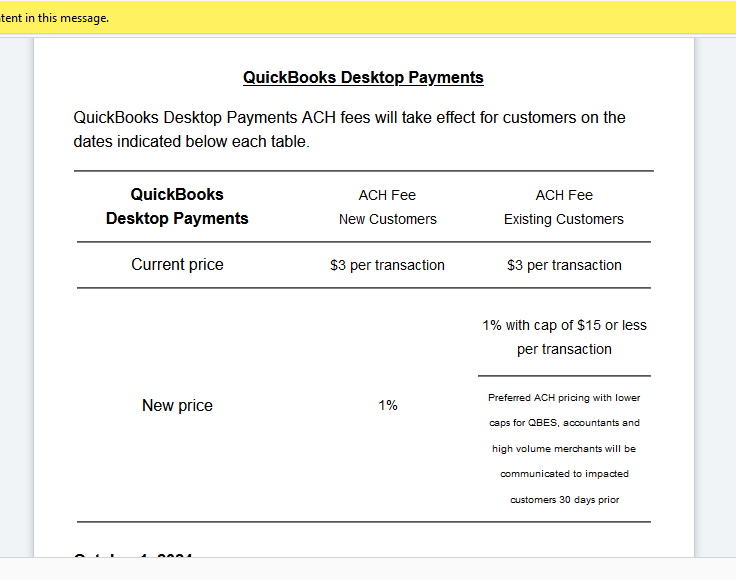
The product my client and I use is Quickbooks Online.
Quickbooks Desktop is actually a completely separate product that Intuit is doing it’s level best to completely kill off with sky-high pricing and fast approaching end-of-support so that they can force everyone to their cloud-based subscription which is fast becoming even more expensive than the desktop version of the software was.
But at least on desktop, you paid once and could run as many different sets of books as you wished. Online…not so much…separate subscription for each one!
So imagine how I might not have thought anything about this little blurb at the bottom of an EMAIL…for all intents and purposes, it looked like they were talking about the payment functionality in the desktop version of the software, not the cloud version!
It’s the same story on the portal in an article released at the same time as the EMAIL.
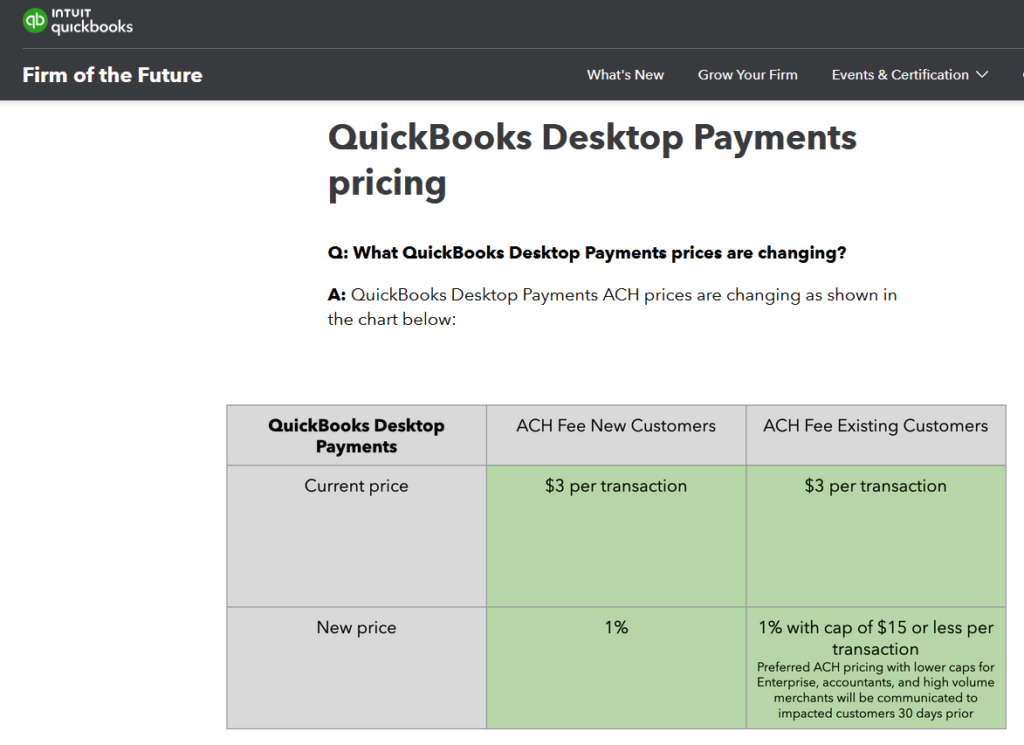
If that wasn’t bad enough, then there was this insult added on to the injury:
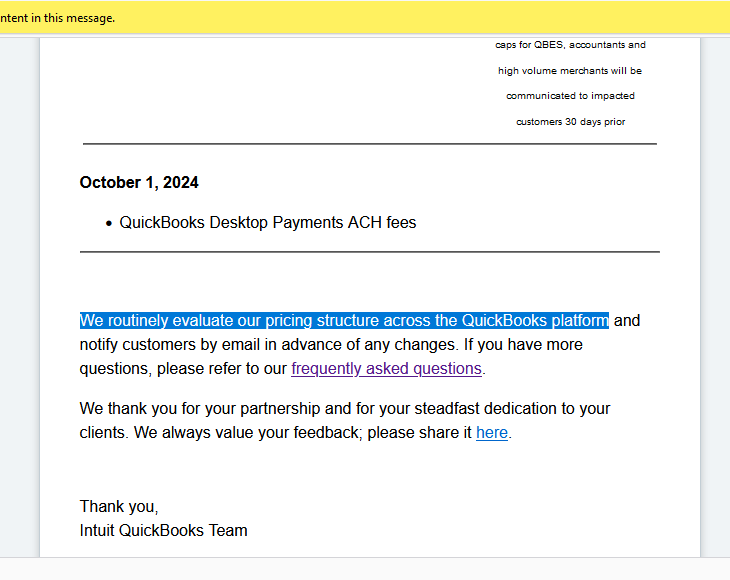
Translation: we have inordinate market share tantamount to a monopoly and we can do as we see fit and reach into your pockets and take as much money as we think we can get away with.
And that’s on top of at least two *OTHER* price increases this year alone and a gratuitous cash grab in ProConnect Tax making me pay for functionality I already had (printing and E-filing returns) for an extra feature I’d rarely if ever need.
Don’t get me wrong…I’ve used Quickbooks in one form or another for over 25 years and only recently was forced to convert to the cloud version of the software. I was perfectly happy with Quickbooks 2010 desktop even though it wasn’t getting any updates or support. I didn’t need either of them for my business, to be honest.
I’ll admit that most of the time I’m actually fiddling in Quickbooks Online on the iPad in a more comfortable chair than in The Nerdery. I kind of like that!
But don’t tell me you’re all about me being successful and then rob me blind and do everything in your power to make sure I’m anything other than someone to be exploited without a care in the world.
Whoever wrote that marketing blurb may not have intended me to feel that way upon reading it.
Perhaps if they were on the other end of the screwing, they might well think differently.
I can’t say that other payment processors that integrate into Quickbooks Online are any less evil or greedy in their fee structures. Generally, third party plug-ins aren’t quite as seamless or easy to use and introduce additional security risks with an integration API.
So be careful if you’re accepting payments in Quickbooks (whether it’s online or desktop) and if you’ve not checked the fees they’re charging you, you just might want to so you don’t get a really nasty surprise when you least expect it.